Consulting innovation · Engagement design
Technical due diligence in procurement
A six-month pilot is an expensive way to discover a system is unsuitable. Insert a targeted technical due diligence between shortlist and pilot, and qualify suppliers out while it is still cheap.
Why
A state education department was running a major system procurement: roughly 20 suppliers, narrowed to six through desktop assessment of written responses, then demos and business due diligence, with a six-month pilot planned to confirm fit.
The question put to them: what happens if the pilot ends and the system is not suitable? Some shortlisted suppliers were consortiums that would no longer have a team ramped up. The business itself would have moved on. They would be starting again, half a year and a lot of money later.
How
- Shorten the shortlist to two.
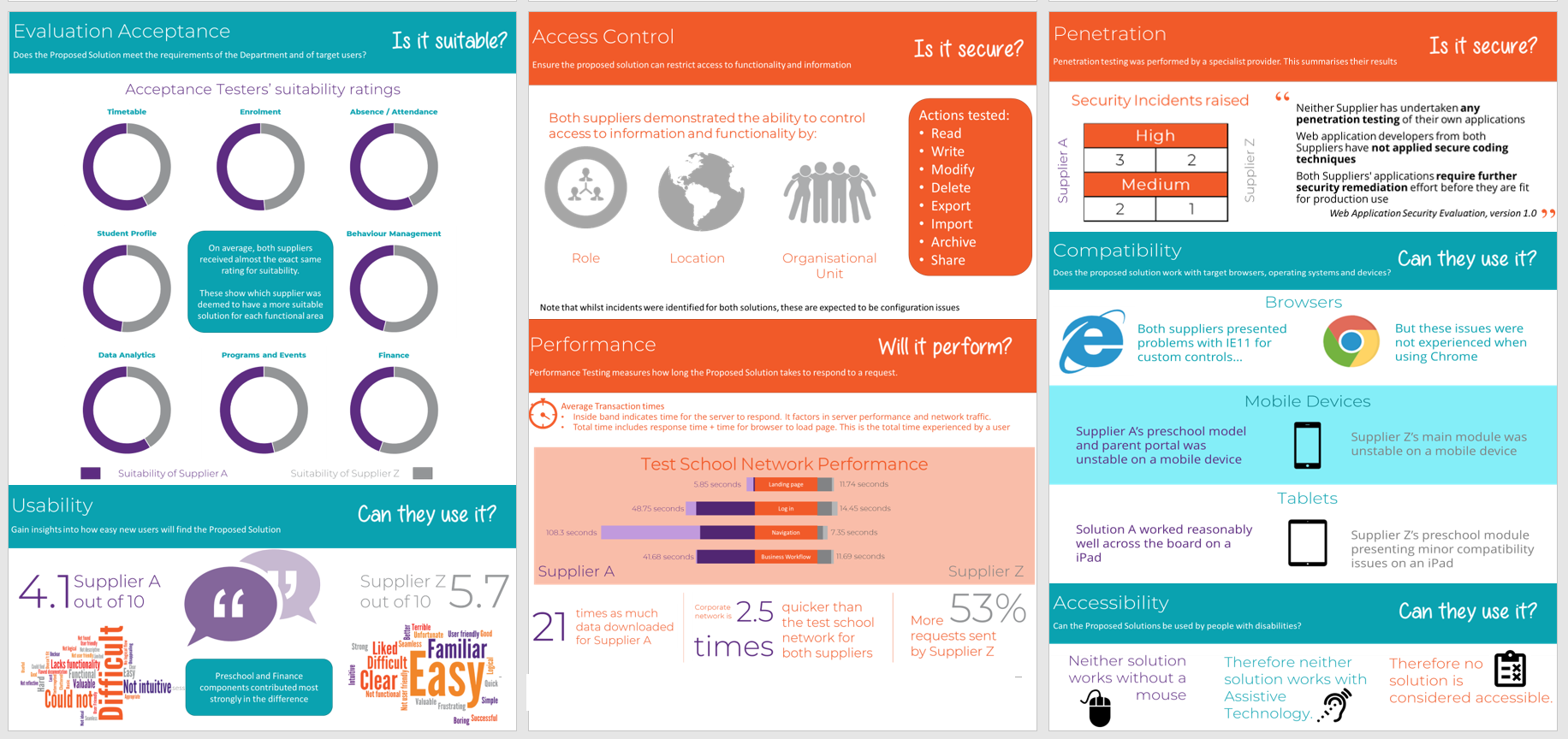
- Design the due diligence around the biggest risks, not full coverage. For this department: fine-grained access control with real-world nuance (a parent subject to a family protection order retains the right to see their child's end-of-term marks, and no right whatsoever to see the child's address); network performance over the poor connectivity of remote schools, where chatty protocols quietly die; compatibility and accessibility; ease of use, because training thousands of staff is a cost line.
- Run it blind and clean. A handful of cleared people saw the systems. The two suppliers were compared as Supplier A and Supplier Z; even the person summarising the results did not know which was which.
- Weight per dimension, and show the workings. Finance, student profiles, data analytics, attendance and the rest evaluated separately, so stakeholders could see how the answer changed depending on what they cared about most.
What
The findings went to stakeholders as infographics rather than registers. The usability word clouds did the most work: one system scored 4.1 out of 10 and returned "difficult", "lacks functionality", "could not", "not intuitive"; the other scored 5.7 and returned "familiar", "easy", "liked", "clear". A modest numeric gap was hiding a large qualitative one, and the pictures made that impossible to miss.
The engagement never tried to test everything. It covered the risks that could sink the pilot and qualified the field down before the expensive commitment. That is the shape of the play: buy certainty where it is cheapest, which is before the contract, not after.