Consulting innovation · Communication design
Sankey scope review
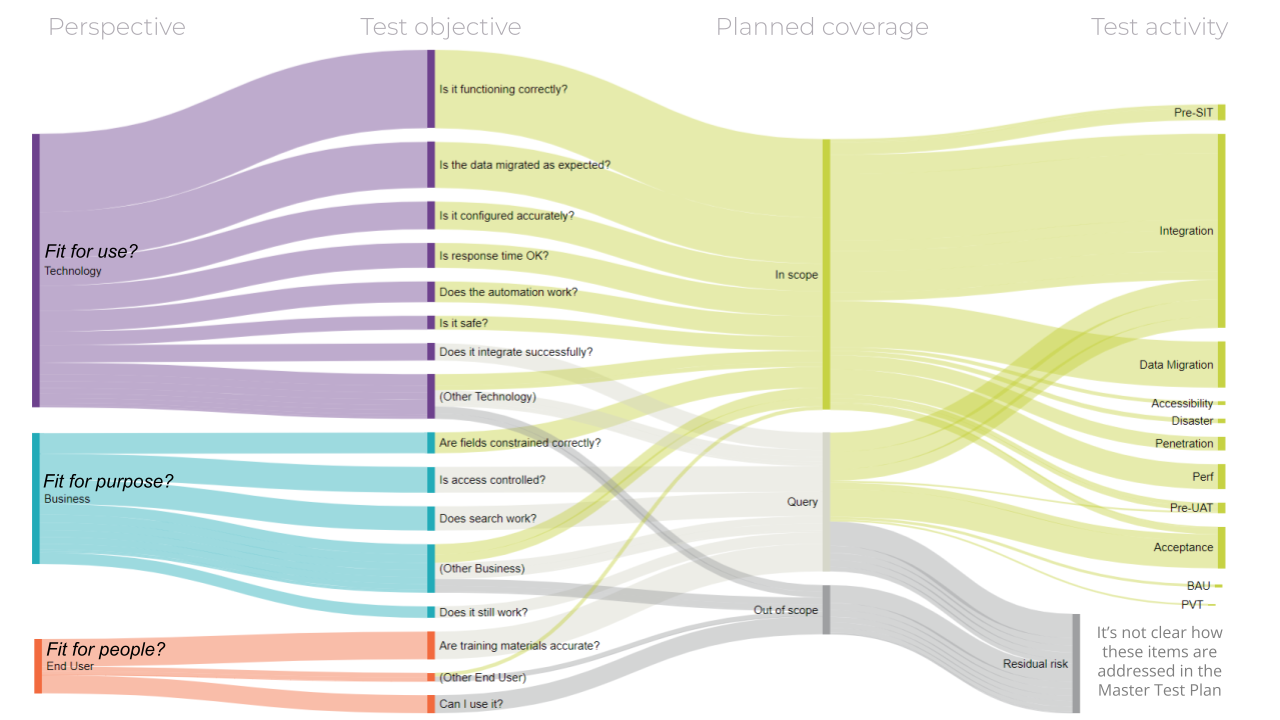
Trace stakeholder priorities through the questions testing must answer, and on to the activities that answer them. Thickness shows importance and rigour. Gaps show themselves.
Why
A test plan can be complete on its own terms and still miss what the business cares about. Reviewing one for completeness by reading it is close to useless: the reader checks the plan against the plan. The real question is whether the planned activities answer the questions that matter, at a depth that matches how much they matter.
How
- Run the risk workshop to elicit the questions testing needs to answer, in the stakeholders' own language.
- Map the existing test plan back against those questions. Every activity lands in one of three buckets: clearly answers a question, clearly out of scope, or "depends on how the question is answered".
- Draw the flow: customer, business, and technology priorities on the left, the questions in the middle, the testing activities on the right. Band thickness carries importance and, with it, the rigour the activity deserves.
What
A state housing authority was part way into a back-end overhaul programme worth over $30 million and asked for a review of an already-established test plan. The workshop elicited the questions the business actually needed answered; the Sankey showed where the plan's coverage concentrated, where the gaps were, and how to rebalance.
The general manager responsible for the programme called it the clearest understanding of what testing was doing she had ever seen.
Programme GM, state housing authorityThe room also produced a recurring lesson about language. The obvious performance question, "does it perform?", fell flat: for that group, "performance" meant anything from employee appraisals to business KPIs. The question that meant the same thing to everyone was "is response time okay?". A later workshop with a different customer needed a different question again, because there "response time" meant how fast staff answered customer queries. Common language is the value. The framework underneath it is scaffolding.